ROBOSCOPE VTM-5000 HELICOPTERS
Laser scanning and flaw detection bench for non-destructive testing of polymer-composite materials used in aircraft constructions: glider elements, helicopter blades and honeycomb panels.
Request QuoteTechnical Specifications
| Testing methods | Impedance, Free vibration, Eddy-current, Ultrasonic (shadow / echo-pulse / phased array / laminar), Laser profilometry |
| Target materials | Polymer-composite materials, helicopter blades, glider elements, honeycomb panels |
| Transducer selection | Fully automated |
| Scan programming | CAD application Method Designer |
| Multi-method NDT | All methods available concurrently |
| Sensitivity adjustment | Layer-by-layer, based on material physical properties |
| Industries | Aerospace, Wind power, Shipbuilding, Pipe fitting |
Description
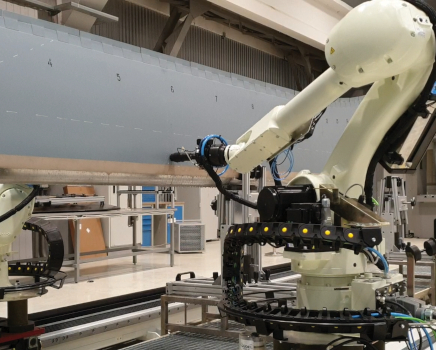
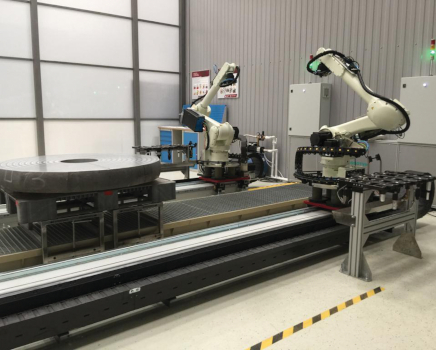
The laser scanning and flaw detection bench ROBOSCOPE VTM-5000 HELICOPTERS is designed for the non-destructive testing of polymer-composite materials used in aircraft constructions: glider elements, helicopter blades, honeycomb panels. It is also suitable for use in wind power engineering, small-scale shipbuilding and pipe fitting production. All tooling (laser scanner, sensors) selection and change processes are automated.
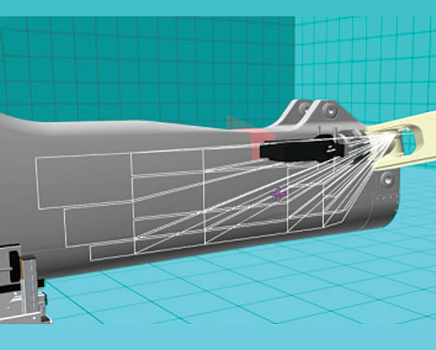
The selection of testing techniques and the choice of transducers are determined during the initialization stage. All NDT methods are available concurrently. The specification of scanning areas, motion paths and testing speed is managed through the CAD application Method Designer. For composite panels, sensitivity adjustment is performed layer by layer, considering the material's physical properties, such as attenuation. In impedance testing mode, an optimal spectrum of probing signals is automatically configured for each material during the initialization process.
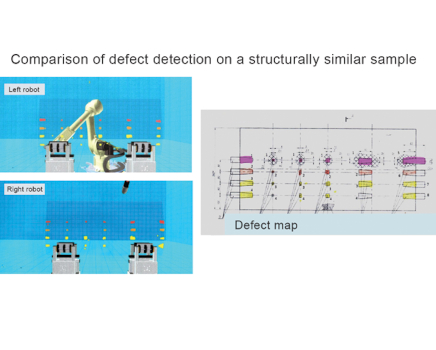
The ROBOSCOPE VTM-5000 HELICOPTERS scalability allows the testing of parts with varying shapes and sizes, and the mechanization criteria are individually defined during the design stage. The system enables efficient completion of the entire testing process, providing a high-precision flaw map that takes into account all applied techniques.
Key Features
Gallery